

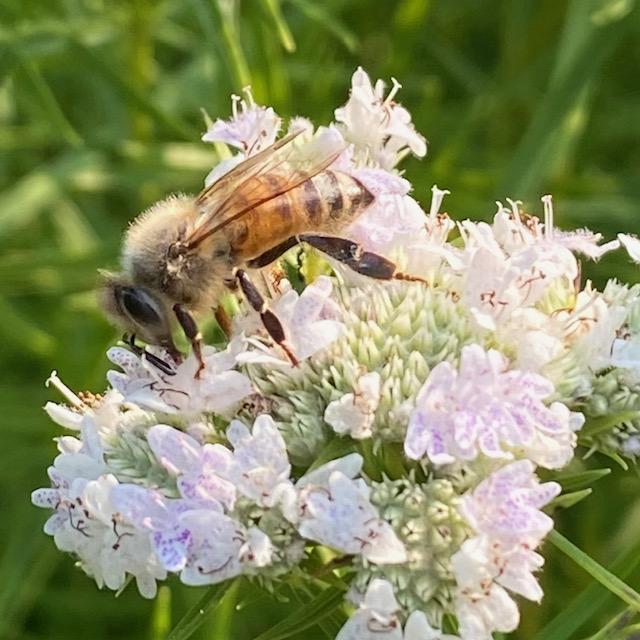
Bees feed us much more than honey. Honeybees pollinate over 100 crops across the United States. According to the Maryland Department of Agriculture, the value of Maryland crops that need pollination is $40 million annually. Beekeepers play a crucial role in ensuring that bees survive. Pesticides, parasitic mites, weather, and queen issues are all foes fought by dedicated commercial businesses and backyard beekeepers. Having more beekeepers means more bees, as annual hive loss rates range from 39% to 50%. In Maryland, 2,300 beekeepers maintain over 18,000 hives, or colonies.

An interest in pollinators led Patty Engler of Bee Haven Farm in Eldersburg, Maryland to begin learning about keeping bees.
“I have always been interested in pollinators, and I think bees are so fascinating. The colony is social, and bees work together by dividing tasks,” she said. ”There are different types of bees in the colony. Most are female, only the Drone bees are male. They each have a job to do. Some forage for food, some take care of the young, some build the comb, some guard the colony, etc.”
Jeanne Mayo of Meadowsong in Reva, Virginia, got her first hives four years ago.
“There is a saying about this. ‘If your bees make it through the winter, you are a beekeeper; otherwise, you are a bee haver – you have bees, but you did not successfully keep them,” she explained. “So, if we look at it this way, I have been a beekeeper for three years. My first year, I was not successful, and the hive was gone on Christmas.”
Mayo started over the following spring, by ordering a “package” of bees. They arrived in a three-pound container of approximately 10,000 bees. She now has two colonies, which could be anywhere from 20,000 to 80,000 bees.
Mayo had familiarity with bees because her brother had kept them for many years, but she was surprised at how it felt to become a beekeeper herself.
“I didn’t expect to feel so protective of these little insects. I also did not realize the amount of equipment I would need – more and more hive boxes and frames and jars and supplies for extracting. It is also very physically demanding, lifting and bending and standing, often in very hot weather dressed in protective gear. “
One challenge bees present is swarming.
“Bees swarm when the population increases; the old queen will leave the hive with about half the bees leaving eggs and larvae behind along with queen cells which have larvae in them that will grow into queen,” Mayo explained. “Managing swarms is a huge challenge. Ideally you can catch a swarm of bees – but you have to have the extra equipment to house a new colony. You also have to be present or know where the swarm went. Then you have to tend to the colony that was left behind – one queen has to emerge, be healthy, and kill all the others before they hatch or they fight to the death. Then she has to go out and get mated and return successfully.”
Honey is the golden product bees produce. A frame of honey will hold eight to ten pounds of honey, as well as wax. Each colony holds eight to ten frames. When asked how much honey her bees produce, Engler explained, “It depends on the year, but usually around 100 lbs. per colony so, close to 200 pounds bottled.”
A common belief holds that local honey helps desensitize people to allergies because it is made from local pollen.
“Raw honey is unpasteurized and contains more beneficial nutrients than pasteurized honey varieties, including compounds containing antioxidants,: Engler told us. “Raw honey may have antibacterial, antifungal, anticancer, and wound-healing properties. Honey is also known for soothing sore throats and is helpful to calm a cough. Honey is a high sugar food so that needs to be considered when balancing out health benefits. Using honey in place of other sweeteners has been found to be beneficial.”
Some who decided to keep hives for the honey have found themselves fascinated with the bees themselves.
“Bees communicate through touch, and movements like dance, also through pheromones,” Engler said.
“Their buzzing is calming,” Mayo noted. “I find it very interesting that in a bee’s life span, they will have multiple jobs that benefit the colony. From Nurse bees that feed the young larvae and queen, to foragers who bring in resources, guards who protect the entrance, and even undertaker bees that carry out the dead.”
Ready to be a bee haver or keeper? Both Mayo and Engler advise educating yourself.
“I took a class through the Carroll County beekeepers club,” Engler said. “I recommend looking for a local beekeeping club before starting beekeeping. The club helps you make decisions about what equipment to buy, provides mentors to help with hive inspections and answer questions, and holds meetings to continue to educate you on beekeeping techniques.”
Echoing those same tips, Mayo said, “Do your research. Take a class and find a mentor. It is not inexpensive, as there are a lot of startup costs, and be prepared for heartbreak. You can do everything right and still not be successful. You’re trying to manage insects, and the bees are going to do what they want to do. You are simply trying to set them up in the best possible environment to produce extra honey that you can harvest.”

An old tradition holds that you have to tell the bees of important news like births, weddings, and deaths. Engler says she follows this.
“I did tell them when the queen died in 2022. But, no, I didn’t hear a response,” she said. How to find out more? Check with your state Department of Agriculture to find out what the law requires. Connect with your state association, a list of which can be found here: https://abfnet.org/beekeeping-organizations/, and consider joining the American Beekeeping Federation https://abfnet.org/.
Lisa Derx is a member of the American Daffodil Society, Membership Chair for the National Capital Dahlia Society, President of Chesapeake Flower Exchange, Local Flowers Liaison for the Independent Floral Designers Association, and a member of the Association of Specialty Cut Flowers and the Maryland Cut Flower Growers Association. Her home is in Dayton, Maryland, where she lives and grows flowers with her husband Dan and cat Sebastian.

Please support OutLook by the Bay with a subscription.
OutLook by the Bay magazine and this website are made possible through the support of our advertisers and subscribers. We guarantee you’ll learn something new each issue. Please subscribe today.