

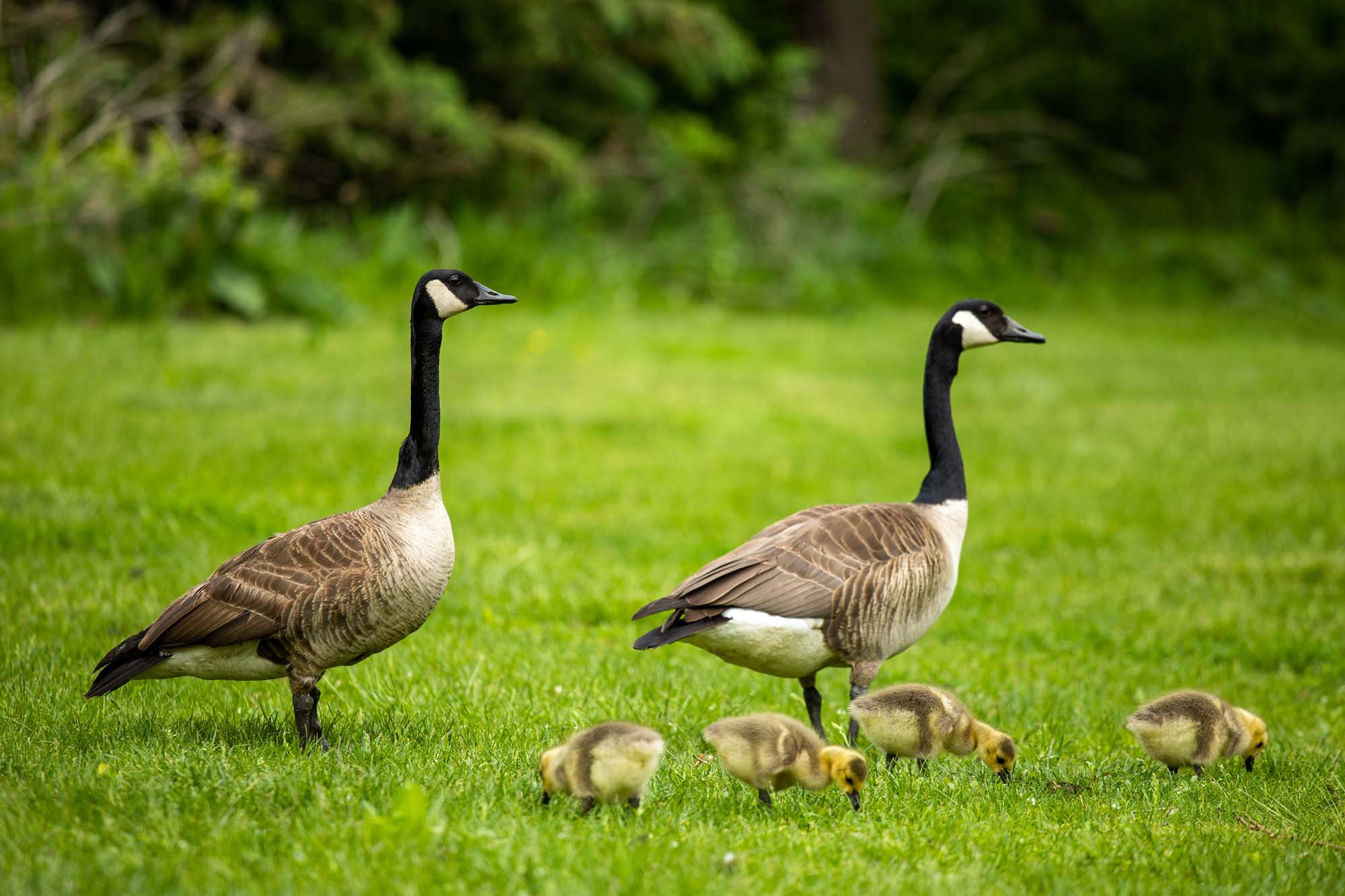
Late every summer, thousands of Canada geese wing southward from their Arctic breeding grounds on Ungava Bay in far northern Quebec. Following the Atlantic Flyway, many end up in Chesapeake Bay, where a third of all migrating waterfowl settle in for the winter, drawn by the estuary’s sheltered waters and abundant feed. We embrace the arrival of the honking, V-shaped formations. The cry of the geese is like the call of the wild.
But lately our love affair with these birds has been waning.
The Canada Goose, Branta canadensis, is a handsome creature. Weighing in at up to twenty-four pounds, with a six-foot wingspan and striking black, white, and gray plumage, even a solitary goose is an imposing sight. They roost in protected open waters and feed on seeds and terrestrial and aquatic vegetation. They’re particularly drawn to cultivated fields and the grain left behind after harvesting. In their overwintering grounds, they initially seek out high-protein food, like certain clovers. They switch to high-energy carbohydrates as the season progresses. They also need a source of grit so their gizzards can grind up food. The geese have few predators but are vulnerable to bacterial, viral, and parasitic diseases. In Maryland, 80-90 percent of Canada geese mortality is from hunting.
It takes several years for Canada geese to reach sexual maturity. They pair up during the winter and usually mate for life. They nest when they return to their northern breeding grounds and produce four to seven eggs that are incubated for three to four weeks. The hatchlings can’t fly until they’re about two months old. Even the adults are flightless during this period while they undergo a wing molt.
So these birds are impressive animals, loyal to their mates, and emblematic of the wild natural world. But, like people, all Canada geese are not alike. They comprise many different subspecies and population groups, each with their own migratory patterns. Those following the Atlantic Flyway are known as the Atlantic Population.
And then there are Giant Canada geese. The same species as our seasonal visitors from northern Quebec, they’re significantly larger. And they don’t migrate. Their origin? In the 19th century hunters and wildlife managers encouraged year-round populations of Canada geese. But by the early 20th Century, hunting and habitat loss had decimated the resident birds. Since then, concerted conservation efforts have restored their numbers, and then some. Giant Canada geese have adapted well to human environments and their populations have grown exponentially.
A success story? Maybe not. Resident Canada geese have now become so numerous that they’re often a nuisance. They’ve overrun parks, playing fields, beaches, and golf courses. They leave a ubiquitous calling card – their excrement. A single goose may produce two pounds of feces every day. So a city park with hundreds of resident geese … well, you can do the numbers.
Poop is not their only problem. Canada geese are highly territorial, especially during breeding season, and they’ll aggressively defend themselves against humans. An attack by a 20-pound goose isn’t much fun. In Chesapeake Bay they’ve been displacing ospreys and eagles from their nests. Resident geese also graze on manicured lawns, ravage crops, and discharge nutrient-rich wastes into waterways. Bird strikes by Canada geese have brought down aircraft. And their droppings may be a vector for harmful viruses – even avian influenza (bird flu).
So, what to do? Widespread culling is out of the question. Public aversion would prevent that, and Canada geese are protected by treaties. But we do have acceptable options. The Maryland Department of Natural Resources (MD-DNR) recommends the following:
- Discourage nesting and remove nesting structures.
- Don’t feed resident birds.
- Steepen slopes of ponds and waterways to make access to/from land more difficult.
- Discourage grazing by eliminating mowing and planting less palatable species.
- Exclude geese, using barriers, scaring devices, lawn sprinklers, dogs, and other means.
In extreme circumstances, MD-DNR suggests applications of chemical repellents and even lethal control, including by expanded hunting and destruction of nests and eggs. Of course, these options require permits.
The bottom line: We can peacefully coexist with resident Canada geese and humanely control their populations. Wild or domesticated, these are magnificent birds.
Henry “Hank” Parker is a scientist and writer who previously lived in Annapolis and now resides in Vermont.

Please support OutLook by the Bay with a subscription.
OutLook by the Bay magazine and this website are made possible through the support of our advertisers and subscribers. We guarantee you’ll learn something new each issue. Please subscribe today.
