
By Lisa Derx
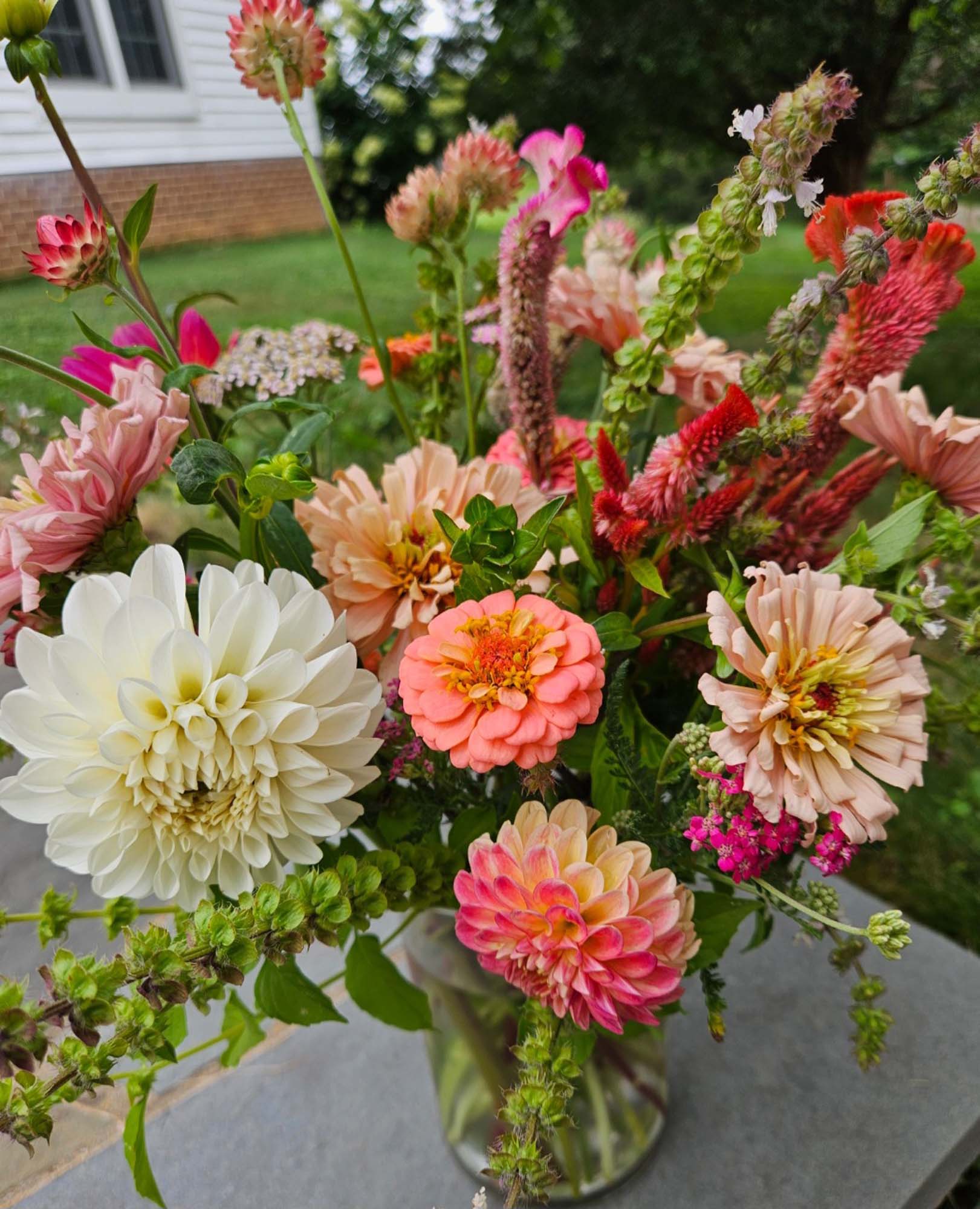
When I first began designing with flowers, I grabbed flowers from the grocery store randomly, and fit them into whatever container I had. While those early vases were riots of color, they were also stuffed with stems or sparsely arranged. They never quite looked like a real arrangement. After reading books on floral design, taking classes, and asking questions, I began to improve. Your designs will, too, if you follow a few easy steps.
First, where will the arrangement be placed? Is this for a hallway table? A dining room centerpiece? For a coffee table? Knowing that tells you approximately how tall the arrangement needs to be. For a table centerpiece, you want the people seated around the table to see each other, so keep designs to no more than 12” high from the bottom of the vase to the top of the tallest flower.
Next, consider the placement and the height of the vase. Most designs should be approximately one and a half to two times the height of the vase. So, if your vase is six inches tall, total height would be nine to twelve inches. If placement is in an especially spacious or tall area, such as an entrance hall, go higher.
What type of vase will you use? Virtually anything that holds water without leaking can be a vase. Common materials are glass or ceramic. Make sure you look at the width of the opening of the vase as 12 stems in a vase that has a very wide neck might look sparse. Those same 12 stems in a vase with a very narrow opening might look overstuffed.
Next, consider the flowers you want to use. How big is your garden and what is blooming? If you need to purchase flowers, what is your budget? Will the arrangement be viewed from just one side, as when placed on a table against a wall, or from all sides, as with a centerpiece? Something viewed from all sides will need more flowers and foliage.
Much like cooking, flower design follows a recipe. Much like interior design, odd numbers of stems look more pleasing. The ingredients follow four main categories:
- Focal flowers are big, showy, and draw the eye effortlessly. Roses, peonies, dahlias, mums, hydrangeas, tulips, and carnations are among the most common.
- Line flowers look exactly as they sound – tall and straight, typically with flowers all along the stem. Reach for snapdragons, stock, larkspur, and delphinium to bring height.
- Filler flowers also give their role away in their name – they fill the spaces in the arrangement. These are often spray forms such as feverfew, Queen Anne’s Lace, and Sweet William that offer delicacy.
- Greenery plays a key role in designing, both giving form to the design and hiding mechanics such as tape, wire, or foam. Consider the size of the leaves – you’ll want large ones for large arrangements, and smaller, finer leaves for smaller designs. Don’t be afraid to mix it up, either, adding different leaf forms or shades.
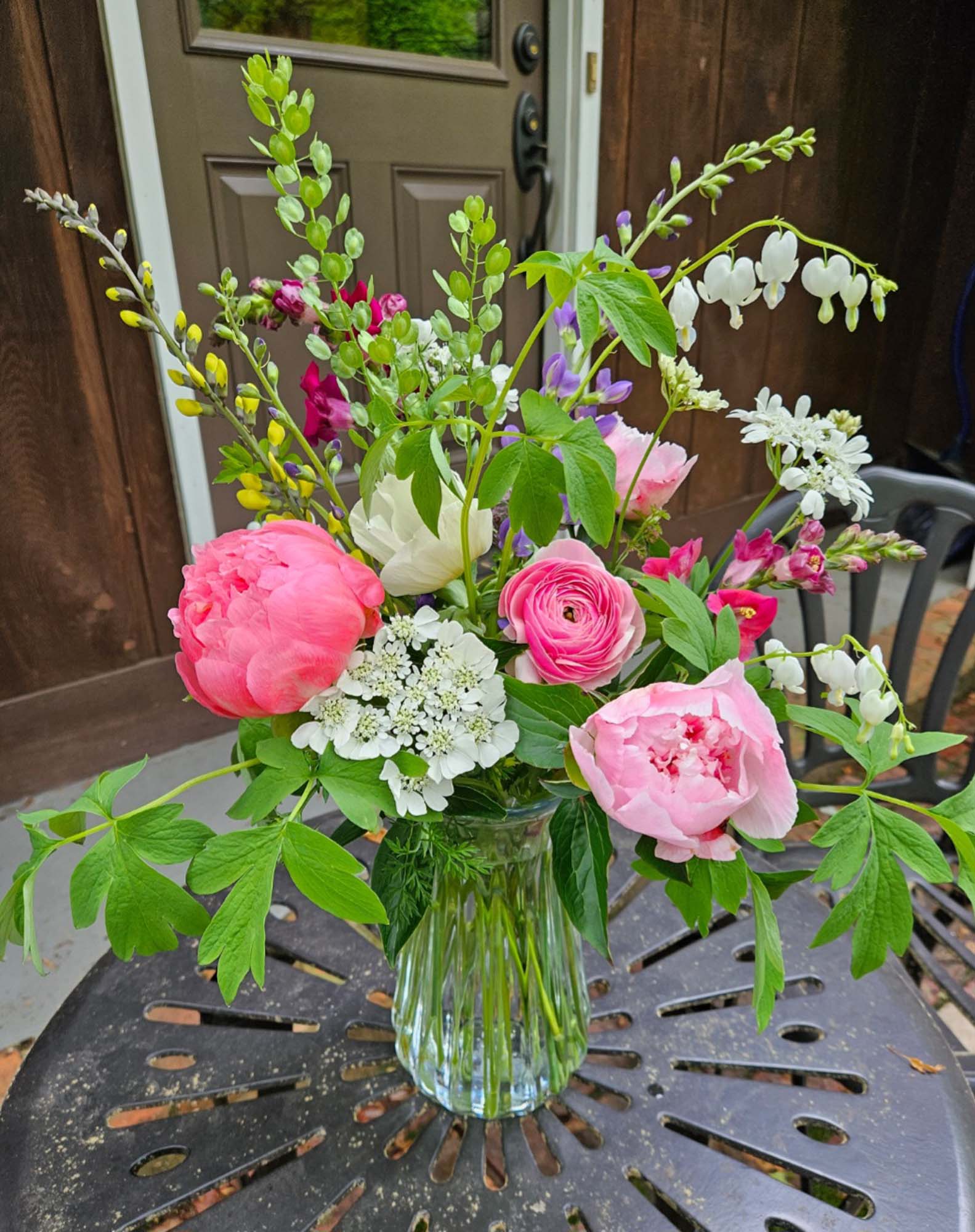
Ready to try designing? Here’s an easy and versatile recipe to follow any time of the year.
Start with a quart-sized clear mason jar with a wide mouth filled with water and flower food. Take clear tape and make a grid across the top of it – three strips across one way, and then three strips across the other. Place one long piece of tape along the outside perimeter of the jar to hold the grid strips securely across the opening. This makes it easy to place each stem and have it stay exactly where you want it.
Placing the greenery first helps form the shape of the arrangement, as well as cover the mechanics. For this size vase, use seven stems, spaced evenly around the grid and in the middle.
Next, place three focal flowers slightly at an angle and spaced evenly. Follow those with three line flowers spaced evenly, and then place three filler flowers.
Arrangements last longer when kept out of direct sunlight. It is also a good idea to keep it away from fruits and vegetables, as many release ethylene gas that will shorten the life of your flowers. Change water every other day. Making a fresh snip also helps the stems absorb the water better, so take a moment to do that if you can. With such care, your flowers will reward you by blooming beautifully for five or more days. Enjoy!
Lisa Derx is a Board member for National Capital Dahlia Society, President of Chesapeake Flower Exchange, Local Flowers Liaison for the Independent Floral Designers Association, and a member of the Association of Specialty Cut Flowers and the Maryland Cut Flower Growers Association. Her home is in Dayton, Maryland, where she grows flowers with her husband, Dan, and cat, Sebastian.

Please support OutLook by the Bay with a subscription.
OutLook by the Bay magazine and this website are made possible through the support of our advertisers and subscribers. We guarantee you’ll learn something new each issue. Please subscribe today.