

By Sharon Schultz
It’s been quite the journey for Baby Boomers who once listened to transistor radios, drove cars with a “stick,” spoke on telephones with dials, and frequented the hub of social interaction, the local malt shoppe! The 1960s have been referred to as “simpler times” it is true, but they were very exciting times, too. The 1964 New York World’s Fair exhibited the very latest technology from around the world. It gave us a vivid glimpse into the future as imagined in 1964, a time when new innovations were more than welcome. But even the New York World’s Fair could not adequately present a fair image of the highly technical existence we enjoy today.
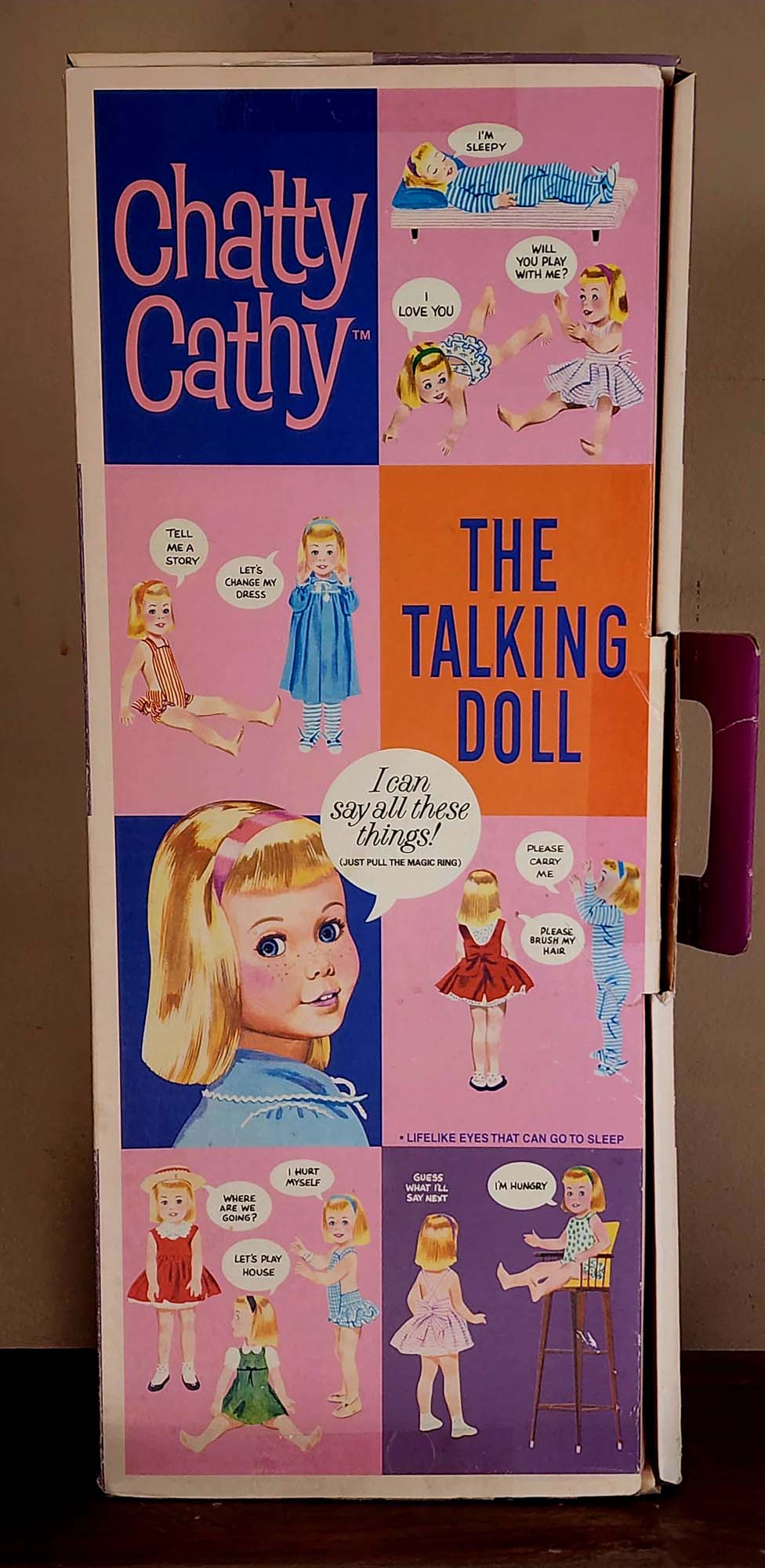
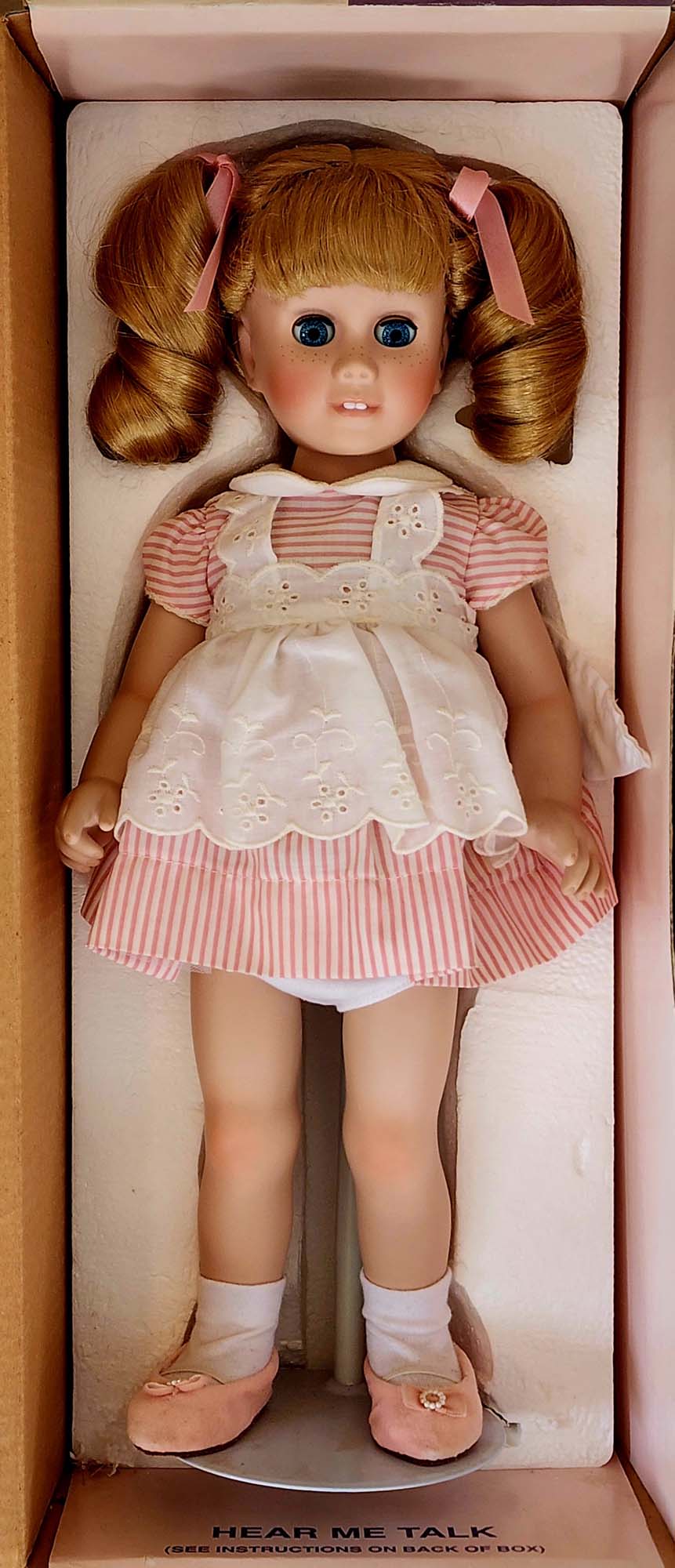
When the Mattel toy company released their first talking doll, Chatty Cathy, in 1960, like many other little girls, it was at the top of my Christmas list that year. Chatty Cathy was built with an ingenious mechanical phonograph in her belly that was activated by pulling a drawstring on her neck. The analog mechanism allowed the doll to “speak” by reciting recorded responses like: “I’m hungry,” “Let’s play house,” “Tell me a story,” “I’m sleepy,” and “I love you.” Wearing a pretty blue sundress, Chatty Cathy’s blue eyes and freckles flattered her perky voice but her responses were limited with no interaction available.
Chatty Cathy was more than a toy. The doll set a course for how people interacted with technology. Humans could communicate with a machine in a way that felt natural. But Chatty Cathy was not the first of her kind. In fact, it was Thomas Edison, Father of Electricity, who introduced one of the first talking dolls to America in 1877! It too had a tiny phonograph with a wax cylinder that played prerecorded nursery rhymes when you turned a handle.
The idea of putting sound inside innate objects eventually led to the development of miniature speakers and digital voice modules that are used in today’s toys and electronics. Talking dolls fueled the integration of audio technology into everyday objects like interactive toys and smart devices. As technology advanced, the discovery of microprocessors and digital sound chips allowed selected toys to store more information, respond to simple triggers, and recognize basic commands. With advances in speech recognition, natural language processing, and machine learning, today’s AI-powered systems can understand complex queries, generate contextually relevant responses, and engage in dynamic conversations. These systems learn from vast datasets, allowing them to continually improve and personalize interactions, far surpassing the capabilities of early talking toys like Chatty Cathy.
As the decades passed, children began to expect more from their toys, craving interaction and response rather than just static play. Talking dolls became more sophisticated, incorporating microchips and sensors to allow for even greater interactivity. The playful conversations of Chatty Cathy laid the groundwork for the development of voice recognition and speech synthesis technologies. Toy companies and tech innovators alike realized the power of conversational machines to delight, educate, and even comfort their users.
Fast forward to the present day, and the legacy of Chatty Cathy is unmistakable. Artificial intelligence has taken the concept of interactive communication to extraordinary heights. Today’s AI-powered virtual assistants, like Alexa, Siri, and Copilot, are direct descendants of that original talking doll, capable of carrying on nuanced conversations, learning from users, and assisting with everyday tasks. They are no longer limited to preset phrases – now, they respond intelligently, answer questions, and evolve with each interaction.
In many ways, Chatty Cathy was the prototype of the friendly voice in our devices. Her string-pulled greetings paved the way for the seamless, voice-activated technologies that surround us. From a child’s cherished toy to the AI companions of today, the journey of interactive technology is a testament to human curiosity and the desire for connection. It all began with a doll who wanted nothing more than to say hello.
Sharon Schultz is a retired freelance photojournalist and proud Bay Boomer.

Please support OutLook by the Bay with a subscription.
OutLook by the Bay magazine and this website are made possible through the support of our advertisers and subscribers. We guarantee you’ll learn something new each issue. Please subscribe today.
