

By Joyce M. White
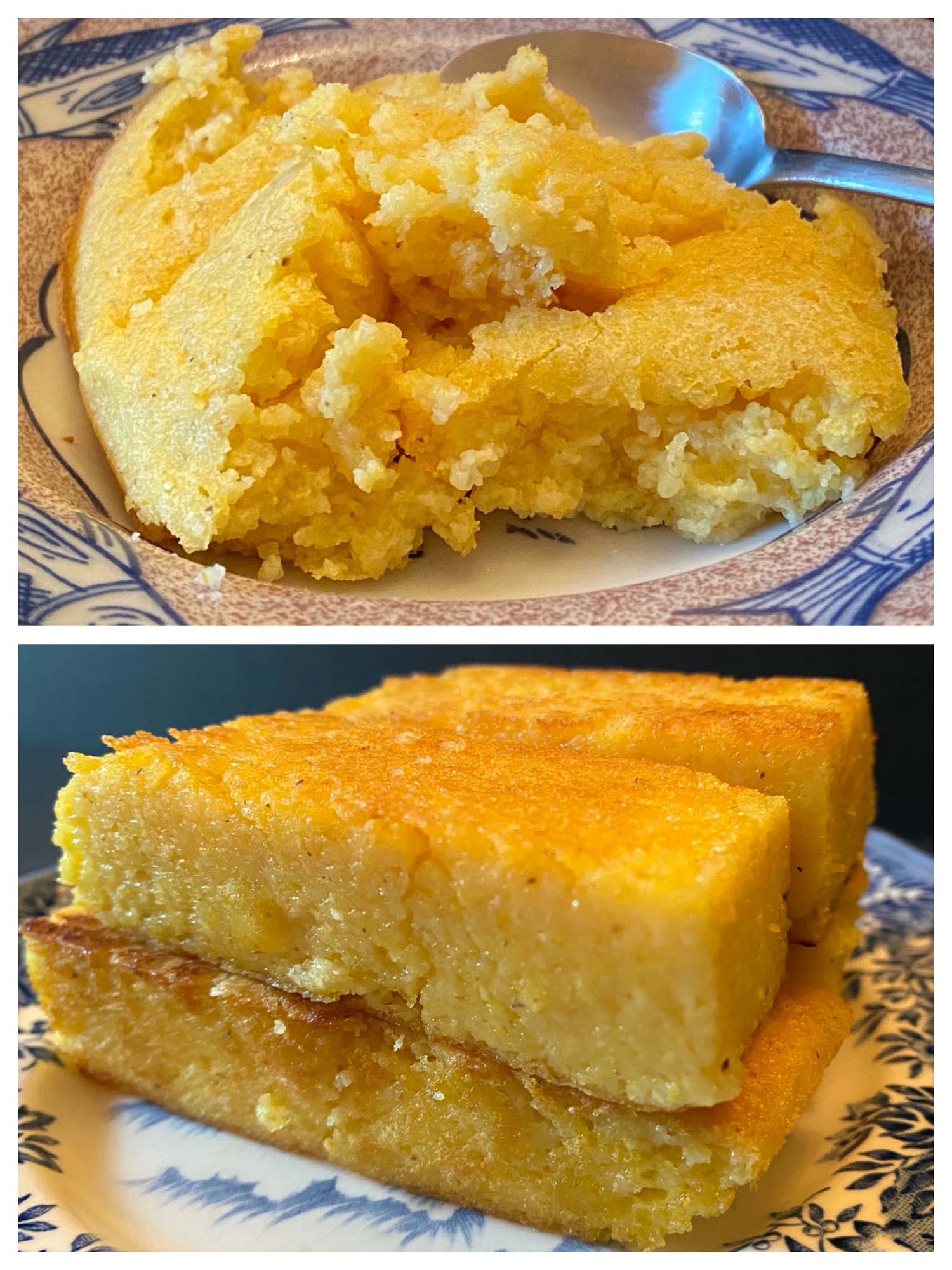
Spoon bread is a distinctly American comfort food in which cooked grits or cornmeal become a moist, custard or pudding-like bread. Warm from the oven, it must be eaten with a spoon – the mixture is too soft to hold in the hand like a slice of bread – hence the name. Once cooled, it firms into a dense loaf that can be sliced and panfried. These crisp slices can be doused with maple syrup, honey, or molasses for a second life as a sweet fried bread.
Spoon bread’s origins are rooted in an indigenous American bread called corn pone, where cornmeal and water are cooked into a porridge and then shaped into small patties, which are cooked in the embers of a fire. Over time, ingredients such as milk, eggs, sugar, and leavening were added, and cooking methods diversified – they started to be baked in an oven, fried in fat, or cooked on a griddle, all of which produced distinct textures. Spoon bread emerged as a wet, custardy version of those original dense pones. Sometimes, spoon bread is even referred to as pone; these pones were historically made with various starches besides cornmeal, such as sweet potato and cassava. In Africa, the tradition of using grains such as wheat, oats, and barley, as well as yam tubers, to make thick porridges similar to pone and spoon bread was well established. It is no surprise then that Africans forced to work as enslaved laborers in the Caribbean islands developed methods for making sweet potato pone, a dense, spoon-like bread enriched with coconut milk. Consequently, old food traditions combined with New World staple foods to create a much-needed form of sustenance that augmented daily calorie intake and nutritional levels.
By the nineteenth century, spoon bread recipes began appearing in printed cookbooks, especially across the American south. One of the earliest known recipes appears in Sarah Rutledge’s “The Carolina Housewife” (1847), where she offers Owendaw Corn Bread and Corn Spoon Bread. Rutledge described Owendaw Corn Bread as having “the appearance, when cooked, of a baked batter pudding,” with “almost the delicacy of a baked custard.” Her words capture the essential appeal: spoon bread sits between pone and pudding – rich, tender, and comforting.
Throughout the twentieth century, the dish maintained popularity, especially in mid-Atlantic and Southern kitchens. Historic Maryland cookbooks and manuscripts, for example, contain numerous spoonbread and cornpone recipes. Family and community cookbooks preserved local variations and personal touches – more eggs for a silkier texture, extra butter for richness, or a dash of sugar to highlight after-dinner sweetness.
For a particularly decadent Maryland cornbread, travel to Taylor’s BBQ in Salisbury on the Eastern Shore to try their famous wet cornbread, an extra decadent type of spoon bread. If you want to sample classic spoon bread at home, try Auntie’s Spoon Bread, a recipe from the “Hammond-Harwood House Cook Book” (1963). The finished dish is lightly browned on top, moist within, and fragrant with butter. Serve it warm from the oven with a pat of butter and a drizzle of syrup, or let it chill, slice it, and panfry slices until they’re golden and crisp.
Joyce M. White, a food historian, can be contacted through www.atasteofhistory.net.
Modern Adaptation of Auntie’s Spoon Bread
- 1½ to 2 cups of milk
- 1 cup cooked grits
- 4 tablespoons butter
- 1 cup stone-ground cornmeal
- 2 teaspoons baking powder
- 1 teaspoon salt
- 1 tablespoon sugar
- 2 eggs
- Heat oven to 375º F. and grease a 2-quart baking dish.
- In a saucepan, heat the water and salt until boiling. Slowly whisk in the grits. Reduce the heat to low, cover, and cook for 12-15 minutes, or until the grits are soft.
- While the grits are cooking, mix the cornmeal, baking powder, salt, and sugar. Set aside.
- Pour the hot grits into a large mixing bowl. Mix in the milk, melted butter, and eggs.
- Mix the dry ingredients into the wet.
- Pour into the prepared dish and bake for 45 minutes or until the center does not jiggle when shaken.
- Serve warm, fresh from the oven with molasses, honey, or syrup; or, allow to cool and solidify, then slice and fry in butter or lard.

Please support OutLook by the Bay with a subscription.
OutLook by the Bay magazine and this website are made possible through the support of our advertisers and subscribers. We guarantee you’ll learn something new each issue. Please subscribe today.
