
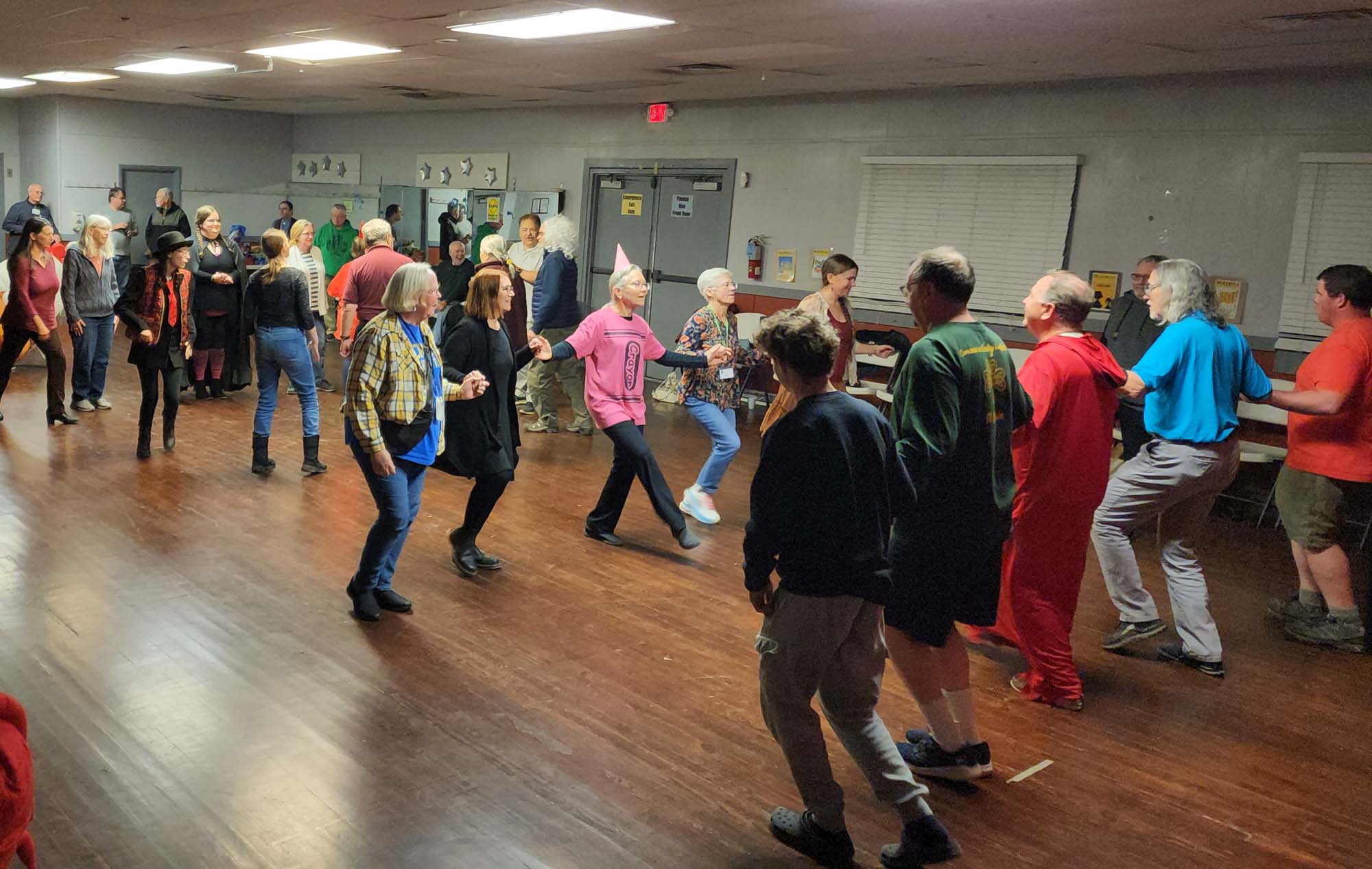

When the subject of Irish dancing is introduced in a conversation, many people immediately think of Irish Step Dancing and conjure up images of young people dressed in bright, clan colors, kicking their heels up higher than they are tall.
The Irish dancing that I’m referring to is more like a country line-dancing, folksy square-dancing situation. It is intended to be performed by several dancers in groups moving in unison in a specific pattern, to the beat of lively, traditional tunes played live by Irish musicians. That sounds like a party, and that is what Irish Ceili (pronounced kālē) and Irish Set Dancing are all about.
Celtic dancing is as old as dirt. Original dances then were purposeful. There were rain dances, work dances, and dances for fertility and courtship. There were dances that worshipped nature, prevented wars and paid homage to higher beings. Ceili dances carry titles that often indicate the village or event, where or when the dance originated. Dances like Connemara Reel Set, Siege of Ennis, Cashel Set, Harvest Time Jig, Caledonia, etc., are informational names.

Clara Finnegan is President of The Emerald Isle Club (EIC), a Baltimore organization that is dedicated to Irish dancing. She is knowledgeable in all aspects of Irish dance, having practiced it for most of her life.
“Ceili is used to describe a particular kind of dance,” Clara began.
“Most Céilí dances are progressive, similar to what we would recognize as a line dance, with groups of two, three or four people in pairs of facing lines. After dancing with the partners facing them, the pairs pass through and repeat with the next set of dancers.”
Here in America, Ceilis are commonly arranged by a variety of Irish Schools of Dance Irish organizations like The Emerald Isle Club in Baltimore and the Greater Washington Ceili Club (GWCC) in Silver Spring, which host monthly Ceilis. Irish language retreats called Irish Language Immersion Weekends will typically involve a Ceili as part of the program. In Ireland, however, Ceilis are prone to pop up in a pub, anywhere, anytime; spontaneity being a common denominator.
The second type of Irish dancing still used today is called Set Dancing.
“Set dances are also often performed at a Céilí, but these are very different,” said Finnegan.
“They grew out of French Quadrilles that were popular near the end of the 19th century. These are usually done in groups of four couples arranged in a square. They are more complicated and many of the dances are choreographed.”
With the population of Irish Americans far surpassing the number of native Irish in Ireland, it is not difficult to find an Irish club in the area. It was Irish immigrants who built the first steam locomotive in the U.S. at Mount Clare Station, and laid the first 13 miles of railroad track from Baltimore to Ellicott City.

EIC has a highly diverse membership that is all inclusive. Ceili Dances are held one Saturday per month from September to June and have a huge turnout with many active members eager to get up and dance. These dances are open to people of all ages, not members only, with many families in attendance.
As President of EIC and a student of Irish dance since 1980, Finnegan understands the health and the social benefits gained from such energetic dancing.
“Irish social dancing is truly designed for people of all ages,” she emphasized.
“While it can be very energetic, it is easy to adjust the level of activity to match your ability. You will often see younger dancers swinging and dancing with enthusiasm. At the same time, it’s not unusual to see dancers in their 70s and 80s on the floor dancing waltzes, jigs and reels at a more moderate pace. It’s a great way to get some aerobic exercise and exercise your mind at the same time!”
The social aspect of Irish dance could not be more beneficial to those who participate. Each dance requires a group effort orchestrated by a mix of friends, family and strangers of all ages, experienced and novice, holding hands trustingly, and laughing heartily as they spin each other across the dance floor while moving in sync with other dancers. It does require focus. Dancers must listen to the steps being called out and ensure their feet are moving in the right direction while remaining in step with their partner and the other dancers!
The exercise benefits gained here are undeniable, as is the social interaction that occurs between the dancers. But it is the vibe emanating from the dance crowd that is the greatest benefit. When all the participants are fully engaged, and the roar of laughter becomes louder than the host calling the dance moves, the smiles on their faces are quite evident and will, likely, last well into the evening and beyond.
The Emerald Isle Club hosts monthly Ceilis at a new location just off the Baltimore Beltway called The Promenade Dance Studio, 2605 Lord Baltimore Drive, Suite L, in Windsor Mill, MD. For dance details and dates, visit www.emeraldisleclub.com/
The Greater Washington Ceili Club (GWCC) sponsors monthly Ceili dances held at The Lyceum, 17801 Meeting House Road in Silver Spring, MD. For details and dates, go to www.gwcc-online.org.
Sharon Schultz is a retired freelance photojournalist and proud Bay Boomer.

Please support OutLook by the Bay with a subscription.
OutLook by the Bay magazine and this website are made possible through the support of our advertisers and subscribers. We guarantee you’ll learn something new each issue. Please subscribe today.
