
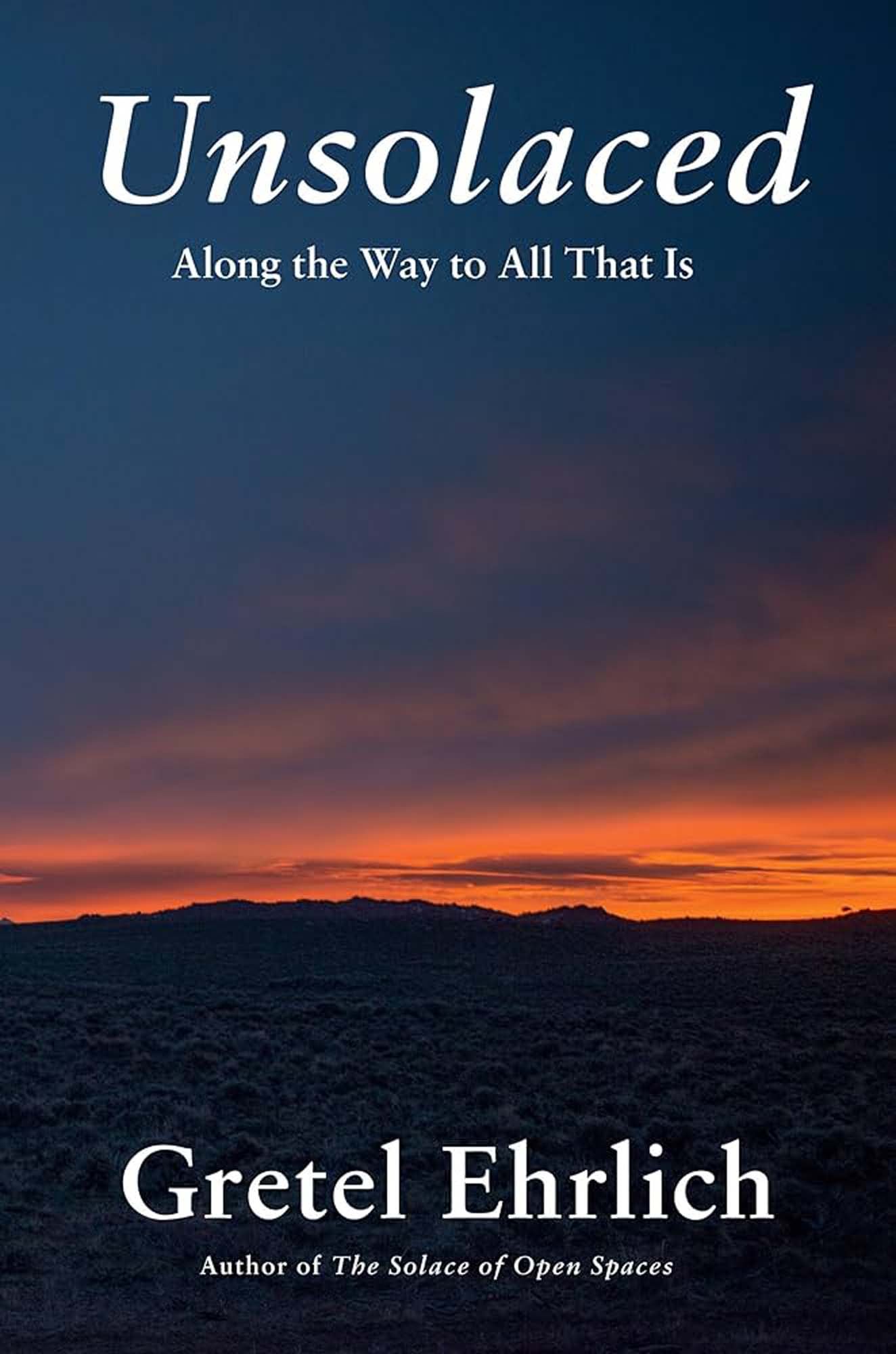
In Unsolaced, Gretel Erlich has written a memoir that is a cautionary tale about the status of the wild world in which we all live. We travel with her to an uninhabited Alaskan island, Africa, Kosovo, Japan and Greenland. We also learn of her life on ranches in Wyoming where she practices herd rotation, similar to crop rotation, to make sure that the land can regenerate itself.
While Greenland has been in recent political news, Erlich’s experiences over more than two decades should bring us fear from an ecological point of view. We have heard about the melting of glaciers and sea ice due to global warming. However, reading her chapters describing dog sled travels over vanishing ice and mountains are frightening. The changes she finds over the passage of several years between visits are remarkable. “Sea ice that had been 10 feet thick in winter and spring was now only seven inches thick.” As well as the impact on global warming, this has jeopardized the many small villages where people depended on ice for travel to hunt for food.
One learns here that the melting and deformation of Greenland’s inner ice is caused not only by temperature but by impurities like wildfire ash from fires and industrial soot from North America. The melting of the deep ice is releasing more than a trillion tons of carbon into the atmosphere which will also hasten temperature rise.
Erlich’s trips to Africa were guided by Allan Savory whose Africa Centre for Holistic Management is in Western Zimbabwe. Savory’s lifework began saving wildlife in Rhodesia, which was no longer politically possible. His emphasis has been on efforts to regenerate deteriorating grasslands not only on the reserve, but as a worldwide influence. His work to regenerate grasslands was “to bring back life to degraded soil and reverse climate change.”
A chance meeting in an airport, introduced Erlich to Rifat Latifi, an Albanian Kosovar who was a trauma surgeon in the United States, but had developed a telemedicine project. His goal is to bring “virtual medicine to post-conflict, developing nations around the world.” Erlich accepts Latifi’s invitation and spends time in Kosovo witnessing the impact of the Serb’s ethnic cleansing on the people of the city and their small hometowns.
As dramatic as these and the other journeys described in this memoir may be, Erlich also experienced great trauma when she was struck by lightning. It took three years to recover, and there are lingering effects. This is a brave woman who has led a courageous life of adventure in the world and cowboying on ranches and at her homestead in Wyoming. A prolific author of memoirs, novels and narrative nonfiction, she is to be admired. For those of us without courage, reading Unsolaced can open our eyes to the wider world and the effects of war and global warming on those who live far away.
– Mary Barbera

Please support OutLook by the Bay with a subscription.
OutLook by the Bay magazine and this website are made possible through the support of our advertisers and subscribers. We guarantee you’ll learn something new each issue. Please subscribe today.